Understanding modern RCS pricing is now vital for telecommunications leaders. The commercial landscape of RCS Business Messaging has matured beyond experimental pilots. Consequently, it has become a critical revenue stream for the B2B messaging ecosystem.
The pricing architecture for RCS is no longer a simple flat rate. Instead, it is a dynamic model driven by message types, carrier policies, and session windows. Telecom leaders must evaluate the differences between transport fees and conversational session economics to maximise ROI.
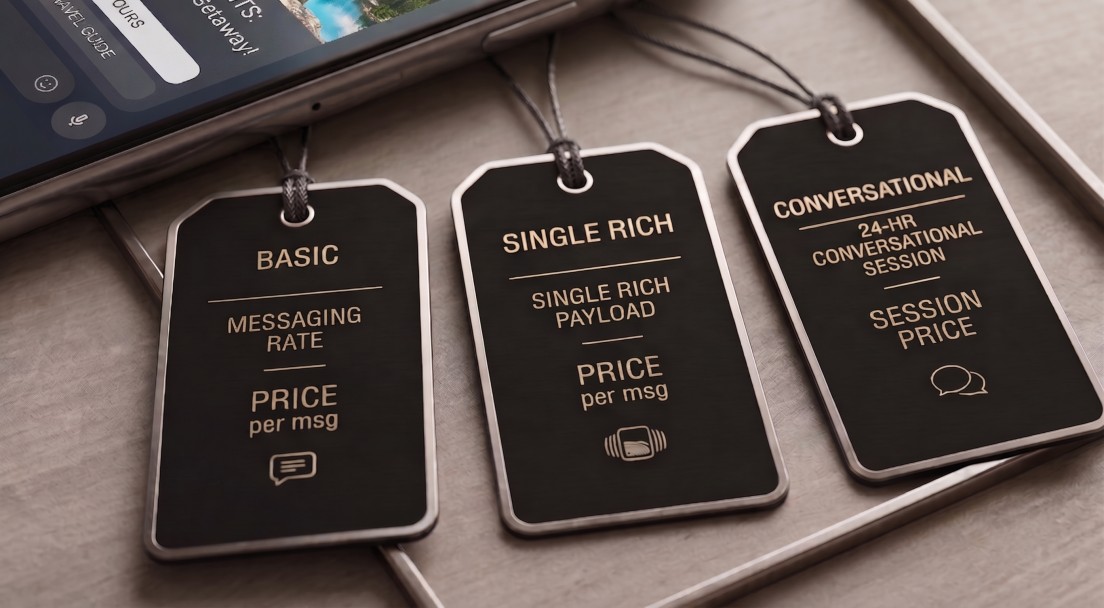
The Tripartite RCS Pricing Architecture
The commercial framework for RCS diverges significantly from SMS billing. Current market structures, standardised by the GSMA Universal Profile, divide traffic into three distinct tiers.
1. Basic Messaging
Basic messaging serves as the entry point for verified brand communication. It provides verified sender profiles and delivery receipts without heavy media payloads. Therefore, operators often price this tier at parity with regular A2P SMS. North American rates typically range from $0.005 to $0.008 per message.
2. Single Rich Messages
The Single Rich Message tier introduces multimedia elements like carousels and PDF files. Because rendering these files requires higher data transport, this tier commands a cost premium. Total costs usually average $0.015 to $0.030 per message, according to Telnyx pricing benchmarks.
3. Conversational RCS
Conversational RCS pricing provides the most transformative model for enterprise economics. Operators charge a single fixed fee for a 24-hour session window. Once initiated, brands can send unlimited messages within that window. This structure decouples cost from volume, as detailed in AWS End User Messaging documentation.
The United States pricing framework is slightly different
While international markets adopt the GSMA standard 24-hour conversational session model, US operators apply a distinct per-message billing framework. In the United States, carriers (AT&T, Verizon, T-Mobile) do not use the GSMA’s traditional Basic / Single / Conversational terminology, nor do they use 24-hour session billing for domestic traffic.
Instead, US carriers use a per-message/per-segment model categorised as Rich RCS vs. Rich Media RCS:
- Rich RCS (Text/Basic): Billed on a per-160-character segment basis (similar to SMS) for plain text, suggested replies, or simple action links.
- Rich Media RCS: Billed at a flat per-message rate (similar to MMS) as soon as the payload includes rich cards, carousels, or media attachments.
US carriers do not offer the flat 24-hour “Conversational” session window that is common across Europe and APAC. Every message (whether part of an ongoing back-and-forth chat or a single outbound notification) incurs an individual transport and carrier surcharge fee.
Regional RCS Pricing Variations and Carrier Dynamics
Regional RCS pricing remains fragmented globally. These variations stem from bilateral agreements between aggregators and local Mobile Network Operators (MNOs). Local market maturity, RCS Business Messaging active campaigns, and operator strategies directly dictate these final rate cards.
In the United States, carriers predominantly use a per-message model. However, total rates reflect significant carrier pass-through adjustments. For instance, Twilio’s documented carrier fees bring Rich RCS outbound messages to $0.015–$0.025 per segment.
Conversely, European carriers prefer tiered session models. Regional rate structures catalogued by global providers like Plivo highlight these stark international pricing variations:
| Country | Basic RCS (Text) | Single Rich Message | 24-Hour Session | Primary Billing Model |
| United States | $0.005 – $0.008 | $0.015 – $0.025 | $0.025 – $0.040 | Per-message |
| United Kingdom | £0.019 – £0.025 | £0.030 – £0.050 | £0.050 – £0.085 | Hybrid |
| Germany | €0.055 – €0.065 | €0.058 – €0.066 | €0.080 – €0.150 | Session / Tiered Single |
| France | €0.035 – €0.050 | €0.080 – €0.130 | €0.120 – €0.260 | Session-heavy |
| Brazil | $0.008 – $0.012 | $0.015 – $0.022 | $0.030 – $0.055 | Per-message |
Note: These are list prices available publicly on the internet. Real prices may vary depending on a multitude of factors.
Note: Rates reflect combined CPaaS transport and MNO pass-through wholesale ranges.
Comparative Channel Overview: SMS, MMS, OTT, and RCS
Enterprise leaders must evaluate Cost Per Acquisition rather than simple Cost Per Message. SMS remains the lowest-cost layer, but it lacks interactive capabilities. MMS offers visual media, yet it suffers from high rates and low engagement.
| Metric | SMS (Traditional) | MMS (Multimedia) | RCS Business Messaging | OTT (WhatsApp) |
| Media Quality | None | Static Media | High (Carousels/Video) | High (Media/Lists) |
| Interactivity | None | None | High (Suggested Buttons) | Medium (Quick Replies) |
| Verification | Limited | None | Native Branding | Verified Badge |
| Engagement Rate | 4% – 7% CTR | 1.5% – 3.5% CTR | 15% – 30% CTR | 35% – 45% CTR |
| Cost Driver | Segment Count | Payload Size | Message Type / Session | Category Window |
While MMS unit costs are three to five times higher than SMS, engagement gains remain minimal. In contrast, RCS unit costs are slightly higher than basic SMS, but they yield significantly higher click-through rates. Consequently, RCS proves far more cost-effective on a per-conversion basis.
The MMS Pricing Autopsy: Critical Lessons for RCS
The history of Multimedia Messaging Service offers a valuable lesson for modern RCS pricing strategies. MMS failed to capture enterprise market share because of fundamental commercial mistakes.
Avoid the Payload Penalty
MMS failed primarily due to rigid, payload-based cost models. Carriers charged exorbitant rates simply because a message contained an image. Modern RCS pricing avoids this error by charging for customer outcomes rather than byte counts.
Eliminate Fragmentation
Inconsistent rendering across carriers severely damaged enterprise confidence in MMS. Thankfully, the GSMA Universal Profile solves this issue for RCS by guaranteeing visual uniformity across networks.
Focus on Interactive ROI
MMS functioned strictly as a static broadcast medium. Users could not take action directly inside the chat interface. Conversational RCS pricing addresses this limitation by supporting two-way dialogue within a single session fee.
Manage Fallback Pricing Risks
Blind fallback mechanisms can cause unexpected cost spikes. If an RCS message fails and defaults to an MMS channel, costs can unexpectedly jump to $0.10 per message. Modern CPaaS platforms now route fallback traffic to lower SMS tiers to protect enterprise budgets.
To be fair, today, the channel presents a fascinating regional paradox. In Germany, major operators have officially ended MMS infrastructure entirely, forcing enterprises toward RCS. Conversely, markets like Slovenia are experiencing a distinct boost in A2P MMS campaigns, where brands still rely on visual messaging for quick engagement gains.
Navigating the Future of RCS Pricing
CPaaS providers like Twilio, Infobip, and AWS End User Messaging abstract underlying carrier costs for enterprise clients. Most providers utilise pass-through billing while adding a minor platform fee.
Maximising the ROI of RCS pricing requires a shift in how enterprises budget for customer communication. Organisations can no longer treat mobile messaging as a commodity expense based purely on volume. Instead, forward-thinking brands must view RCS as an interactive, end-to-end conversion channel.
To optimise messaging expenditures and maximise campaign performance, enterprise leaders should follow three tactical steps:
- Audit Channel Conversion Rates: Track the full sales funnel instead of evaluating simple unit rates. RCS sessions often deliver higher conversion rates that easily justify their premium pricing over standard SMS.
- Implement Intelligent Routing: Configure your CPaaS platform to utilise dynamic routing. Send rich multimedia via RCS first, but fall back to lower-cost SMS channels whenever interactive features are unavailable.
- Leverage Conversational Sessions: Restructure promotional campaigns to encourage two-way customer dialogue. Taking advantage of 24-hour session windows allows you to maximise total customer engagement without incurring additional per-message fees.
Ultimately, clear RCS pricing models offer a sustainable path forward for modern business messaging. By aligning campaign goals with the right billing tiers, enterprises can dramatically improve customer engagement while keeping messaging budgets completely predictable and under control.